


Designed for Durability
The structural case for direct lending
Direct lending’s established track record of resilient performance through past cycles has rested on a combination of structural protections, disciplined underwriting and meaningful diversification. While these strengths matter in any market, they become especially valuable when market narratives and macroeconomic conditions begin to change. With that durability still central in the case for private credit, investors are sharpening their focus on selectivity, downside resilience and regional differentiation as key factors with the potential to shape the asset class’s next chapter of performance.
Key takeaways:
- Private credit’s value for both investors and sponsors continues to be anchored in a durable return premium over public markets; the influence and control that bilateral negotiation can provide; the ability to provide reliable, flexible financing solutions; and close lender-borrower relationships that can support earlier, more decisive engagement.
- Reinforcing this are the asset class’s structural features (i.e., senior secured positioning, floating-rate income, more conservative documentation) and durable borrower demand, especially in Europe, where constrained bank lending and low private credit penetration signal further potential for future growth.
- Rising dispersion across sectors, geographies and managers makes selectivity increasingly important. In the U.S., sector concentration risk, in particular software-related exposures, is prompting investors to re-evaluate allocations. Europe, by contrast, is a more fragmented, less competitive market that may offer opportunities that are typically more lender-friendly, with stronger protections for creditors.

Private credit: past and present
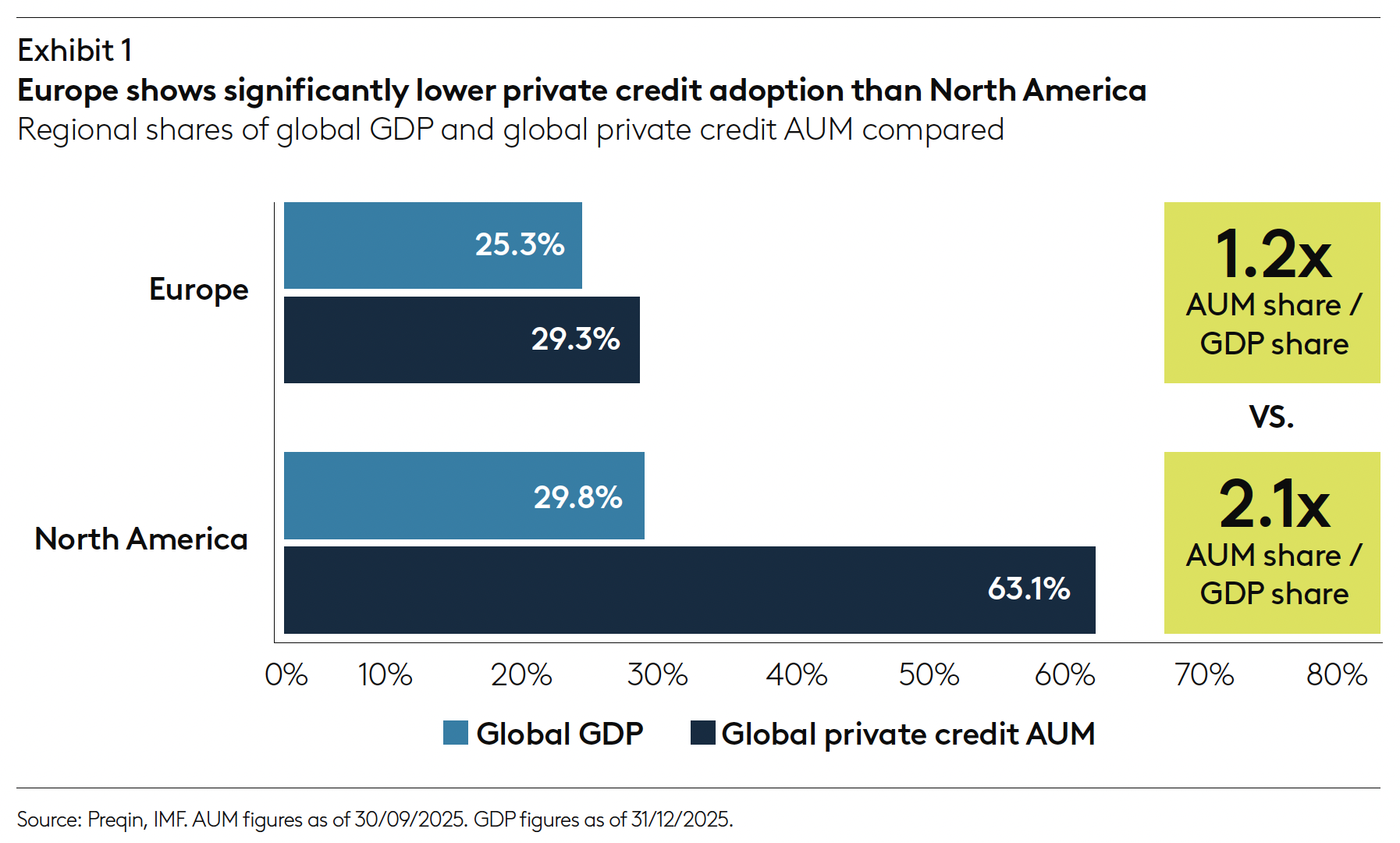
Over the past decade, private credit has become a mainstay allocation in institutional portfolios and a primary financing source for midmarket companies. While that trend is now plain to see, what is perhaps less widely recognised is how much growth potential remains – particularly in Europe, where adoption still trails the U.S. by a wide margin (Exhibit 1).
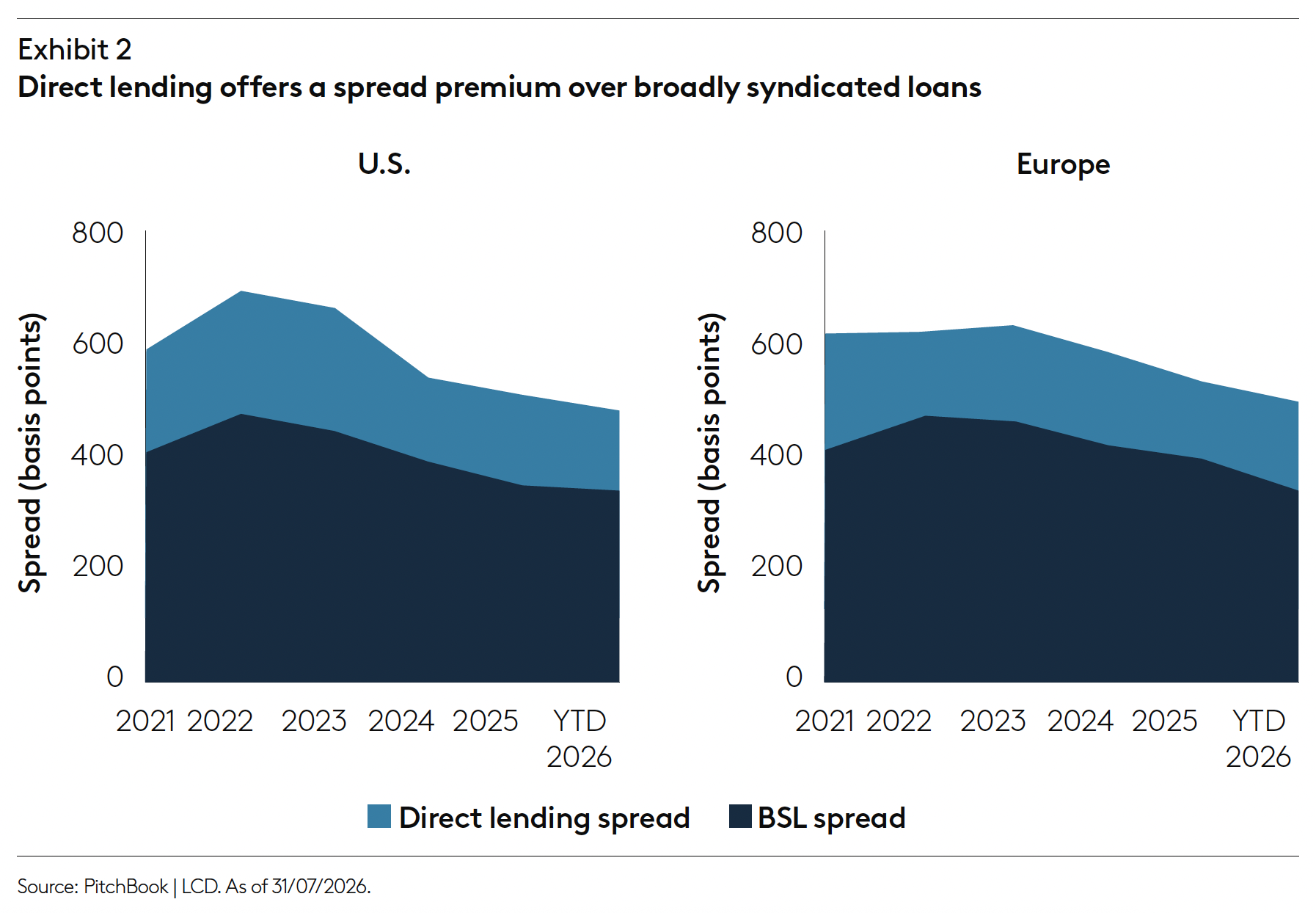
As financial markets evolve, direct lending’s typically senior secured position in the capital structure, spread premium, more conservative documentation, floating-rate coupons and direct lender control should become ever more important to LP portfolios. Spread premia, for instance, have historically been persistent over Broadly Syndicated Loan (BSL) markets and currently stand at roughly 150bps (Exhibit 2).
In our view, market conditions remain broadly supportive, especially for an asset class designed to perform across different market environments. In past cycles, private credit has often been able to deploy into attractive opportunities, particularly when public leveraged loan and high yield markets face volatility and constraints on capital supply. In such periods, private credit’s structural protections can also be reinforced by a manager’s ability to be selective.
Resilient long-term returns
Beyond the skill of individual managers, direct lending’s durability is also structural. The asset class has been designed with a combination of investment features, including attractive income potential and embedded protections, that support resilience through the cycle.
Senior secured position – Direct lending assets are typically senior secured, sitting at the top of the capital structure with the first right of repayment. While not a guarantee of recovery, this provides a built-in buffer against credit deterioration, which matters most when the credit cycle turns.
Private credit premium – Captured in the spread advantage over broadly syndicated loans, this consistent premium represents an attractive and defensive source of return for long-term investors looking beyond shorter-term volatility. This differential reflects a range of factors, including private credit’s market structure and economic features, such as the continued relevance of the Original Issue Discount (OID) in the market.
Stronger documentation – Direct lending documentation, negotiated on a bilateral basis, is generally considered to be stricter than seen in the BSL market. Tighter standards can allow lenders to detect underperformance early and engage constructively with borrowers before value erosion deepens.
Floating-rate structure – The floating-rate structure remains an important portfolio construction tool for institutional investors when managing against uncertain interest rate and inflation paths.
Direct lender control – Small or sole lender groups give direct lenders a direct line to the borrower and the ability to act decisively if circumstances change.
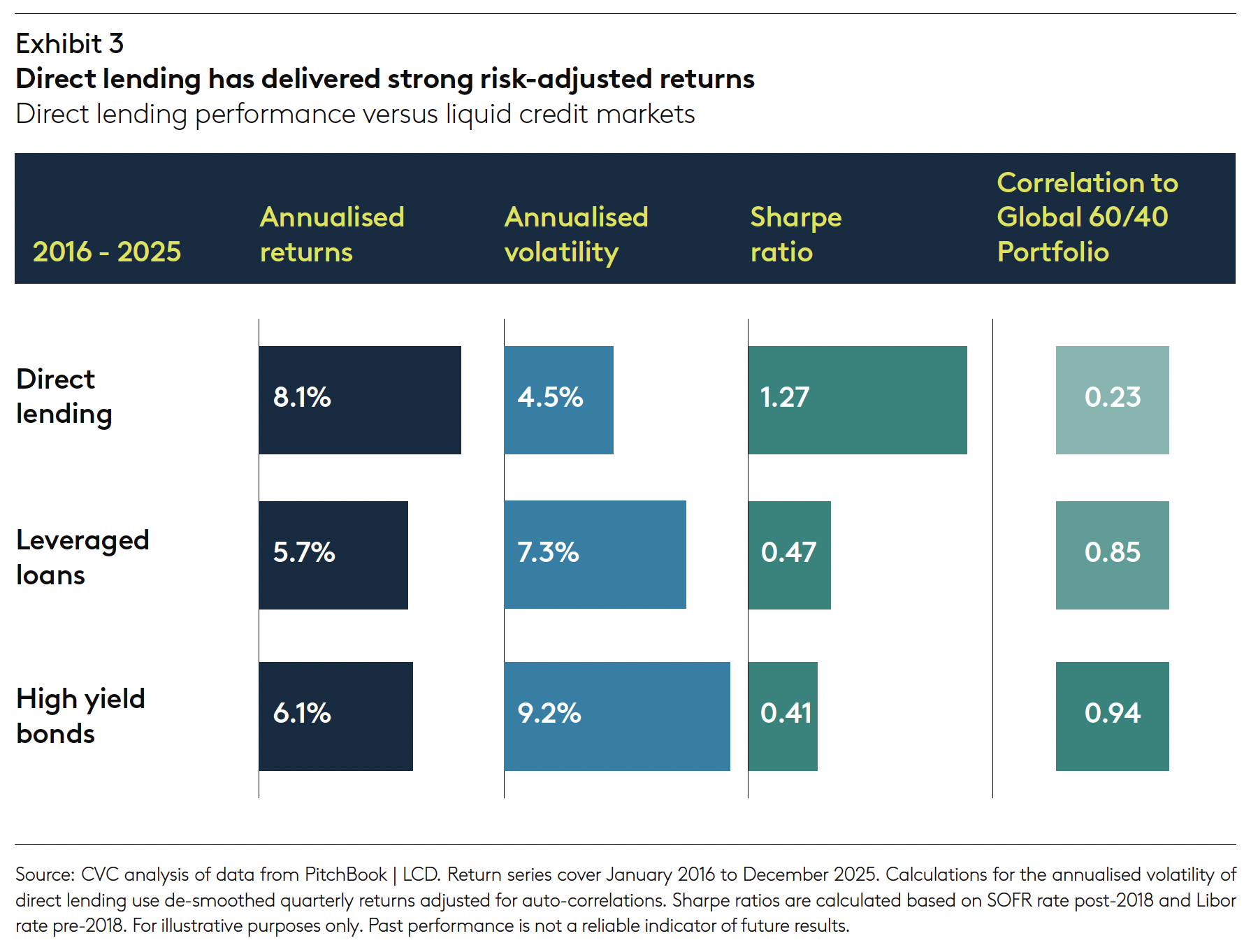
Over the past 10 years, these features helped direct lending deliver higher annualised returns at a lower level of volatility than the leveraged loan and high yield markets (Exhibit 3). Even when adjusting for the smoothing effect of quarterly reporting, which can lead to lower reported volatility in less liquid assets, direct lending’s risk-adjusted returns remain more attractive than other areas of leveraged credit, as does its markedly lower correlation to the traditional 60/40 portfolio.
A growing opportunity set
As with the investment case, the foundations of borrower demand remain firmly intact. Since the Global Financial Crisis, tighter regulation and capital requirements have been a key driver, making it more costly for banks to hold certain types of credit risk. These capital and liquidity rules weigh particularly heavily on leveraged, long-dated, private loans.
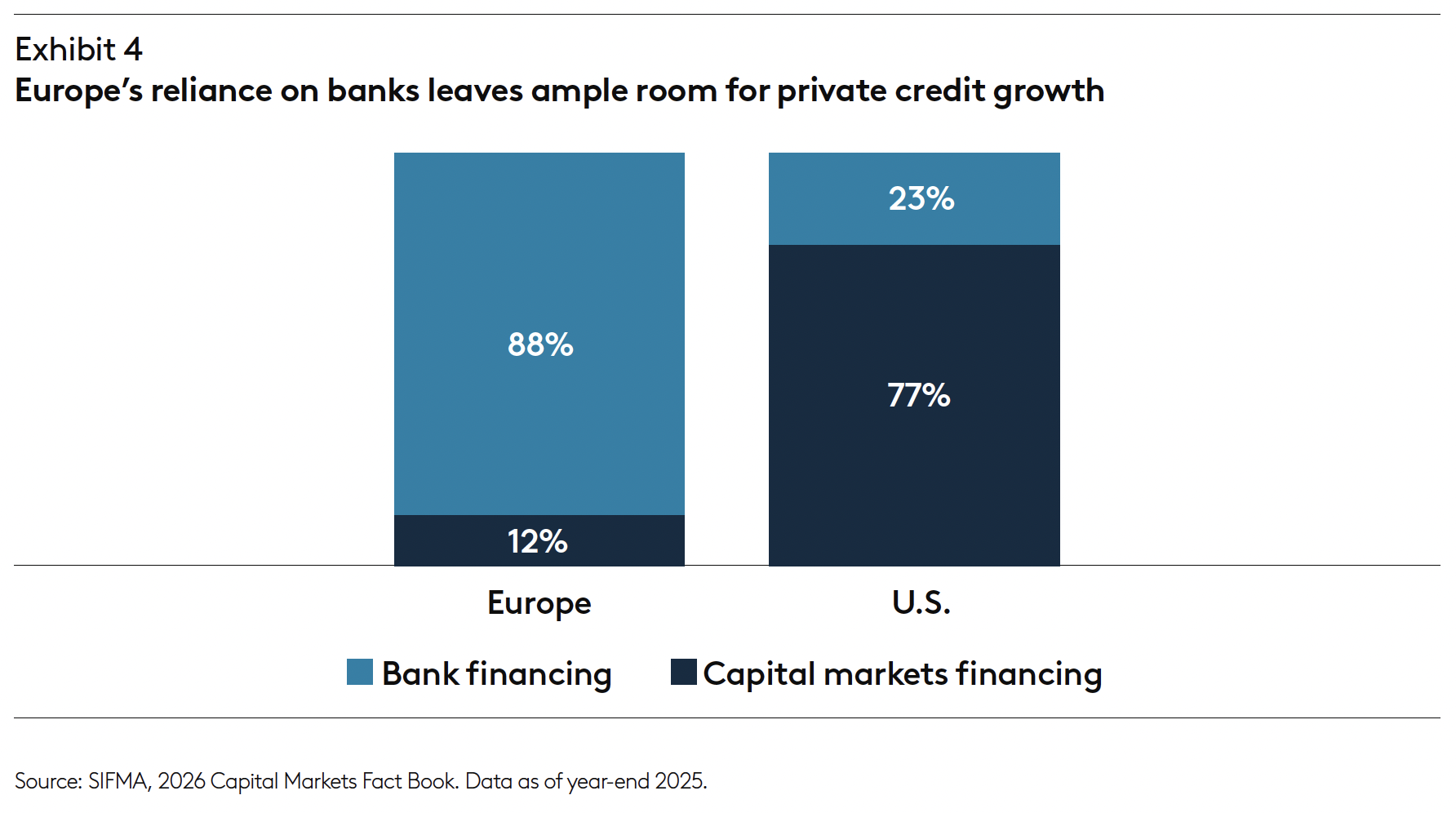
In Europe, the impact is particularly pronounced. Companies still source 88% of debt financing from banks (Exhibit 4), despite these transactions having become far less economical for bank lenders. The situation makes banks less able to cater to certain types of businesses, for example, growth companies seeking follow-on financing. We believe this leaves considerable room for further bank disintermediation, which should, in turn, result in stronger demand for private credit.
At the same time, the direct lending market is itself fragmented, with funds focused on different deal sizes, regions and sectors. This makes established relationships more valuable, as sponsors are more likely to return to lenders who already understand their strategy and financing needs across their portfolios.
Periods of public market volatility reinforce this trend toward disintermediation, as borrowers become more likely to turn to private lenders. However, their preference to go private reflects the genuine benefits direct lenders offer borrowers, including: execution reliability; speed to completion; structuring flexibility; and a focus on deals in the midmarket.
Midmarket companies with EBITDA in the €25m–€100m range typically have a degree of scale and proven resilience that is rarely available at the smaller end of the capitalisation spectrum. However, many still fall between the financing cracks, finding access to the BSL market more difficult than larger peers.
That grants private credit an edge in this segment, a core origination hub for private equity sponsors. Building relationships with these sponsors, who typically have capital to deploy and assets to sell, can support stronger deal pipelines and, by extension, more buoyant transaction activity.
Multi-currency structures are also attractive to borrowers, especially in Europe. Cross-border deals are common and often involve several currencies, other than EUR and USD, which a single private lender can customise and underwrite far more readily than the BSL market. That same flexibility extends to delayed draw facilities, which offer larger commitments and longer draw periods (a key benefit for sponsor-backed M&A).
A hard look at software
The concentration of software in some private credit portfolios, particularly in the U.S., has become the focal point of bearish media headlines this year. On the headline numbers alone, the U.S. BDC universe seems to warrant some scrutiny.1
Software accounts for roughly 21% of aggregate BDC portfolio assets and represents a higher proportion among some outlier funds.2 Yet we do not believe the sector stress in software poses a broad-based risk, as the aggregate figure masks three distinctions that matter:
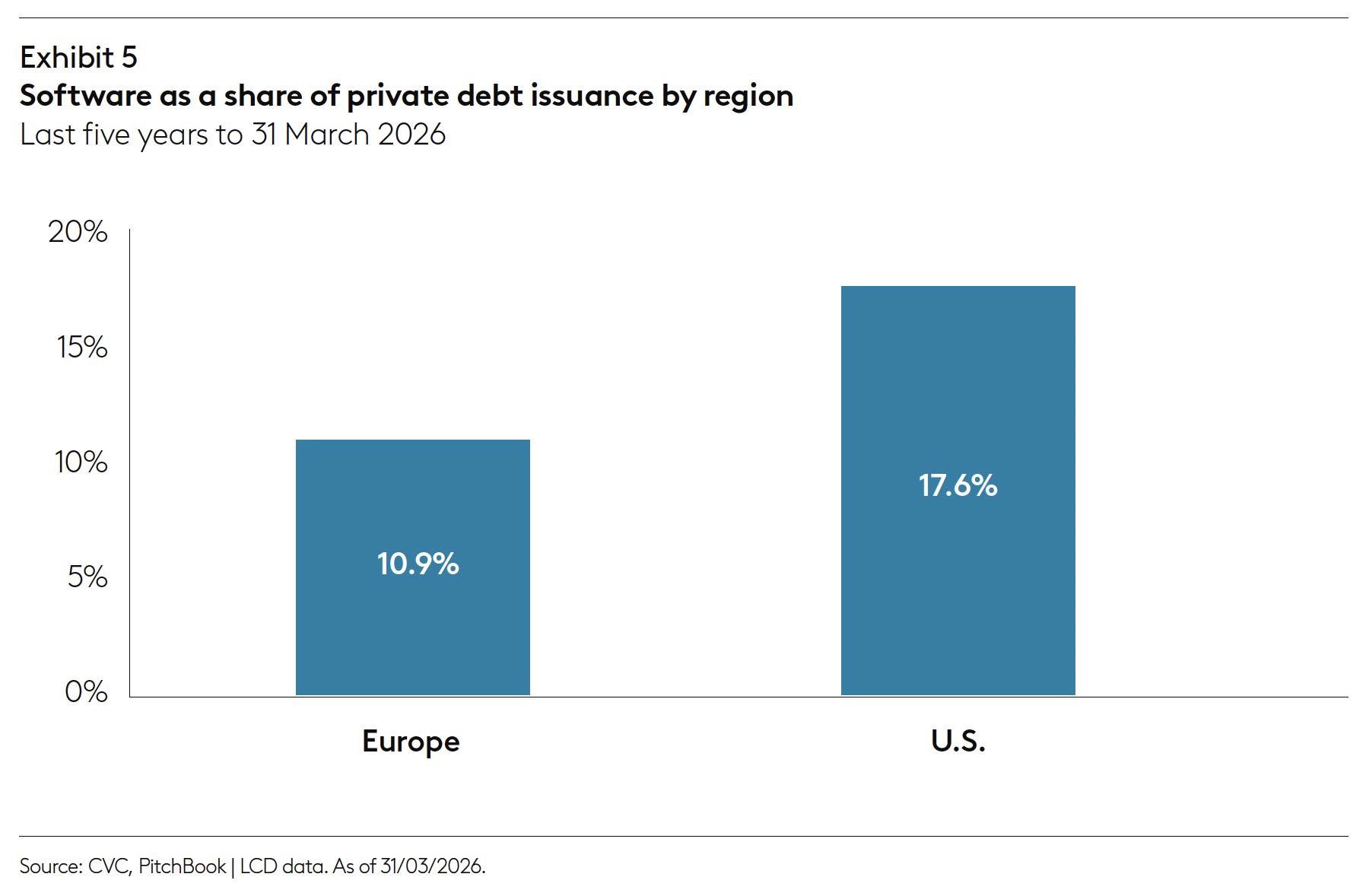
Regional differentiation – The figure speaks only to the U.S. market, not to Europe, where software exposure is estimated to be lower. As Exhibit 5 illustrates, software as a share of total private debt issuance over the past five years has been noticeably lower in Europe at 10.9% than in the U.S. at 17.6%. That gap matters, given investors’ tendency toward home bias, and provides some insight into relative regional risk exposures.
Fund-level variation – Holdings of software loans differ widely across portfolios, with exposures ranging from zero to >30% among some of the largest BDCs,3 which helps explain their higher performance dispersion this year.
Spectrum of risk – The potential for AI disruption is not uniform across the sector. Vulnerabilities vary considerably by business model, depth of customer integration and switching costs (Exhibit 6).
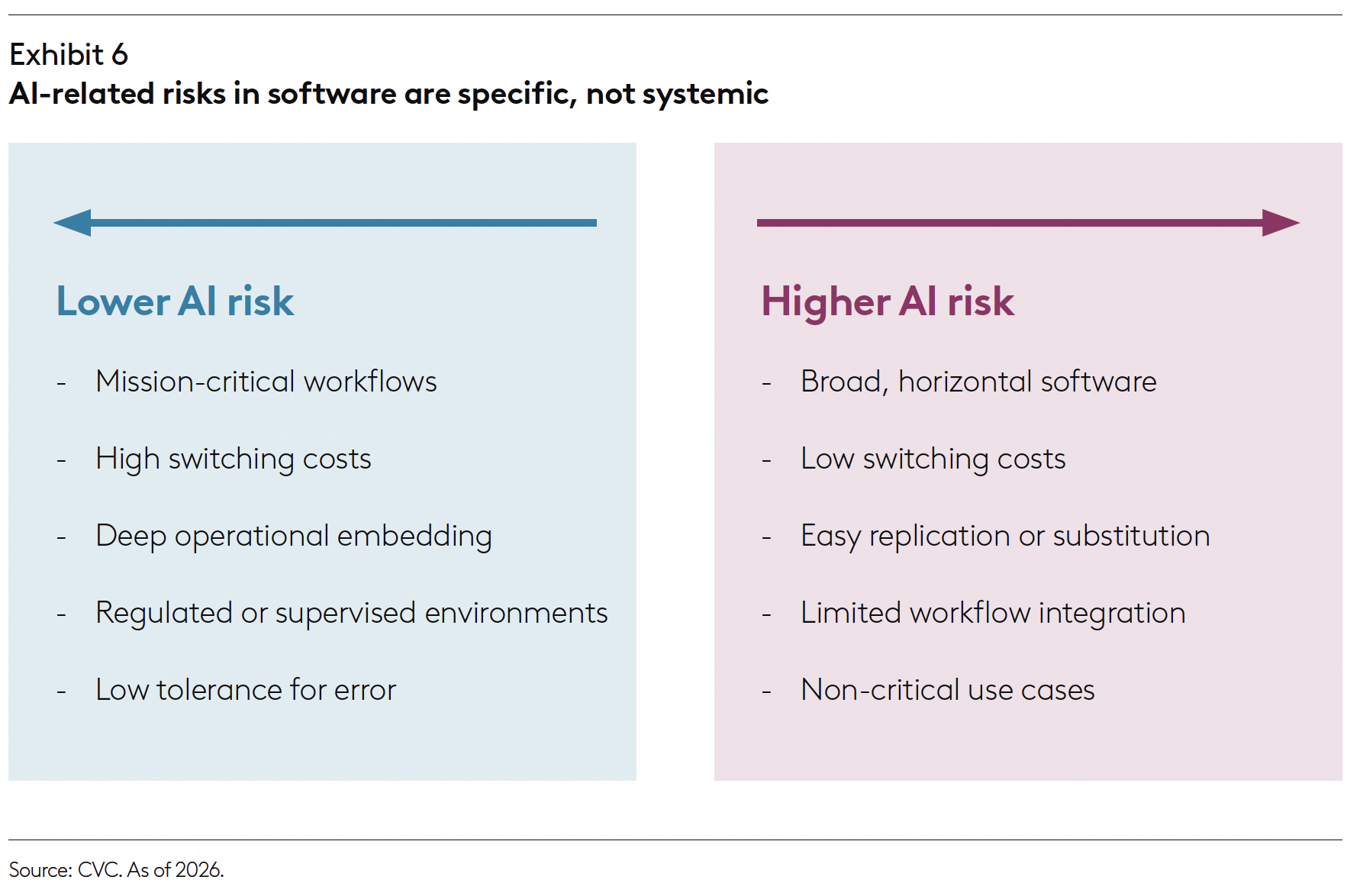
In short, risk varies by borrower, fund and region. For these reasons, we believe recent volatility reflects sector stress more than it does systemic risk.
Although software defaults may tick up and some BDCs now trade at double-digit discounts to NAV, sector developments thus far have been driven more by a sentiment shock than by any significant credit event in software or a step-change in AI automation itself.
Against this backdrop, CVC has maintained a highly selective approach across European direct lending, including in software. This has resulted in a preference for more defensive opportunities at the lower-risk end of the spectrum (Exhibit 6) and an overall reduced emphasis on software than is evident in the broader market.
We assess and monitor AI-related risk throughout origination and portfolio management, supported by a proprietary ‘Software Scorecard.’ Developed in cooperation with team members across CVC’s private equity and wider credit platforms, the scorecard gauges both a company’s exposure to AI disruption and its capacity to turn AI tools to its own advantage.
Regional rebalancing
U.S. equities now dominate global public markets to a striking degree: the U.S. accounts for 72% of the MSCI World Index by market capitalisation and is home to all of the top 10 constituents by index weight. Combined, these 10 listings represent 26% of the index, with 9/10 active in the broader technology space.4
Over time, this level of concentration has likely crept into many investor portfolios, and is already prompting a move to rebalance, both across regions and into other diversifying asset classes. European private markets, and private credit in particular, have been among the primary beneficiaries and are, in many respects, the logical destination for these flows.
European economies tend to grow more slowly than the U.S. but more steadily, offering a counterweight to a U.S. market that is both unusually concentrated and more cyclical. And because national cycles across Europe are not perfectly synchronised, an allocation can carry a further, internal layer of diversification.
Not surprisingly, the rotation toward Europe has gained fresh momentum amid the geopolitical uncertainty of recent years and growing concerns over the long-term strength of U.S. dollar assets.
Europe’s structural advantage
We believe the growing interest reflects several underlying features of the European direct lending market that are often underappreciated. Although the U.S. and Europe have benefited from the rapid growth of direct lending over the past decade, Europe exhibits features that, in our view, support a more defensive risk profile.
European private credit transactions are typically structured with lower starting leverage and more conservative documentation. Covenant protections also tend to be stronger, reflecting a market environment that has historically shown less tolerance for aggressive balance sheet engineering, with more creditor-friendly restructuring frameworks.
European lenders’ more conservative approach is also reflected in cash-flow analysis. Compared with the U.S. market, they typically apply stricter limits to EBITDA addbacks, helping to narrow the gap between reported EBITDA and underlying cash generation.
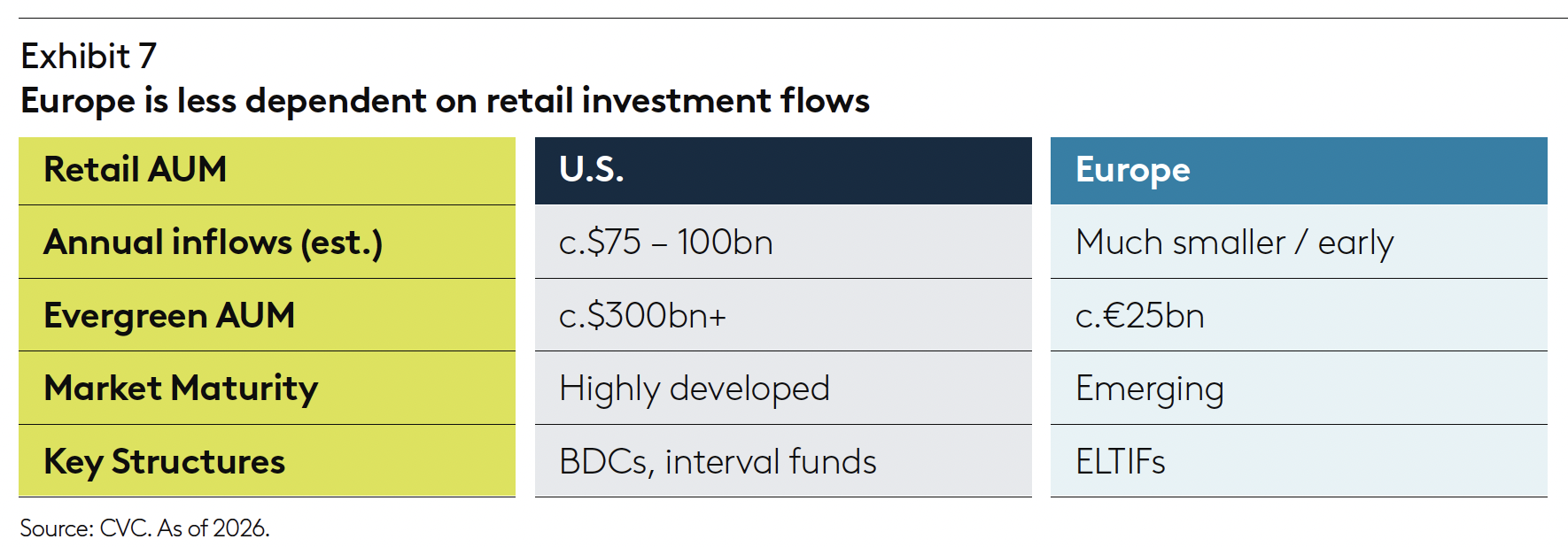
In addition, the investor base in Europe is generally more institutional (Exhibit 7). This reduces the volatility typically associated with retail flows, as seen in the U.S. BDC market, supporting lenders’ ability to pursue a more disciplined approach to underwriting and deal structuring.
Beyond these built-in safeguards, Europe’s more fragmented capital markets continue to offer a structural spread premium relative to the larger and more centralised U.S. market.
This fragmentation can reduce competitive intensity, opening opportunities for lenders to achieve more favourable pricing and terms.
The next chapter: selectivity and scale
Looking ahead, we expect dispersion at the security level to widen across sectors and geographies, resulting in greater dispersion between individual direct lending funds. With a wider range of potential outcomes, disciplined credit selection will become even more important.
In our opinion, the best-positioned GP platforms will be those that combine deep sourcing networks, genuine on-the-ground presence in local markets and fully integrated portfolio- and fund-management teams. Together, these capabilities can reinforce more selective underwriting, helping to mitigate potential risks from higher dispersion for improved performance over the longer term.
GPs that focus on strong downside protection, underwriting discipline and high-quality borrowers in defensive, non-cyclical sectors should be better positioned to navigate this market and any potential inflection points. To this end, building diverse portfolios across sponsors, sectors, countries and vintage years is also key.
Bottom line
Direct lending has become a staple of institutional and strategic asset-allocation portfolios, reflecting both the through-the cycle premia it can deliver and the asset class’s growing maturity.
For many investors, the question today is not whether to allocate to direct lending, but how best to implement that exposure and with which manager. The asset class has matured, and with it, much of the early uncertainty about its durability has faded. Today’s environment, however, sees rising dispersion, which calls for a more nuanced approach that is well suited to managers with strong track records in rigorous underwriting.
Importantly, the structural characteristics that underpinned direct lending’s rise – senior secured positioning, more conservative documentation, the private credit premium, floating-rate income and lender control – remain firmly intact.
At the same time, the continued retreat of banks from midmarket lending, particularly in Europe, is sustaining a strong need for alternative finance. Market dislocation and regional rebalancing are also creating new opportunities, particularly within Europe, where more conservative market structures and a persistent spread premium offer the opportunity for more attractive risk-adjusted returns.
For these reasons, we believe the next chapter of private credit will be defined less by broad market beta and more by the value of selectivity, diversification and disciplined credit investing. In our view, this environment will play to the strengths of the most capable managers and reward the patient capital that backs them.

Important Notice to Recipients:
This paper (this “Paper”) is being provided for information purposes only and does not constitute a recommendation, offer or solicitation to purchase or sell any securities to any person. The opinions expressed herein represent the current, good faith views of the author(s) at the time of publication and are provided for limited purposes, are not definitive investment advice, and should not be relied on as such. Predictions, opinions, and other information contained herein are subject to change continually and without notice and may no longer be true after the date indicated. Nothing contained herein shall be deemed to be binding against, or to create any obligations or commitment on the part of, the addressee nor any of CVC Capital Partners plc, its successors or assigns and any form of entity which is controlled by, or under common control with CVC Capital Partners plc (the “CVC Entities” or “CVC”). No CVC Entity undertakes to provide access to any additional information or to update this Paper or to correct any inaccuracies herein which may become apparent.
Certain information contained herein (including certain forward-looking statements, financial, economic and market information) has been obtained from a number of published and non-published sources prepared by other parties and companies, which may not have been verified and in certain cases has not been updated through the date hereof. While such information from other parties and companies is believed to be reliable for the purpose used herein, no member of CVC, any of their respective affiliates or any of their respective directors, officers, employees, members, partners or shareholders assumes any responsibility for the accuracy or completeness of such information. Certain economic, financial, market and other data and statistics produced by governmental agencies or other sources set forth herein or upon which the CVC analysis and decisions rely may prove inaccurate.
Nothing contained herein shall constitute any assurance, representation or warranty and no responsibility or liability is accepted by CVC or its affiliates as to the accuracy or completeness of any information supplied herein or any assumptions on which such information is based. Further, this Paper reflects only the views of CVC with respect to public and private equity markets and other market participants may hold different views or opinions. Accordingly, each Recipient should conduct their own independent due diligence and not rely on any statement or opinion offered herein.
1 BDCs are vehicles through which retail investors in the U.S. often access direct lending.
2 J.P. Morgan Private Bank. March 2026.
3 J.P. Morgan. April 2026.
4 MSCI. As of 31/07/2026.