January 2026
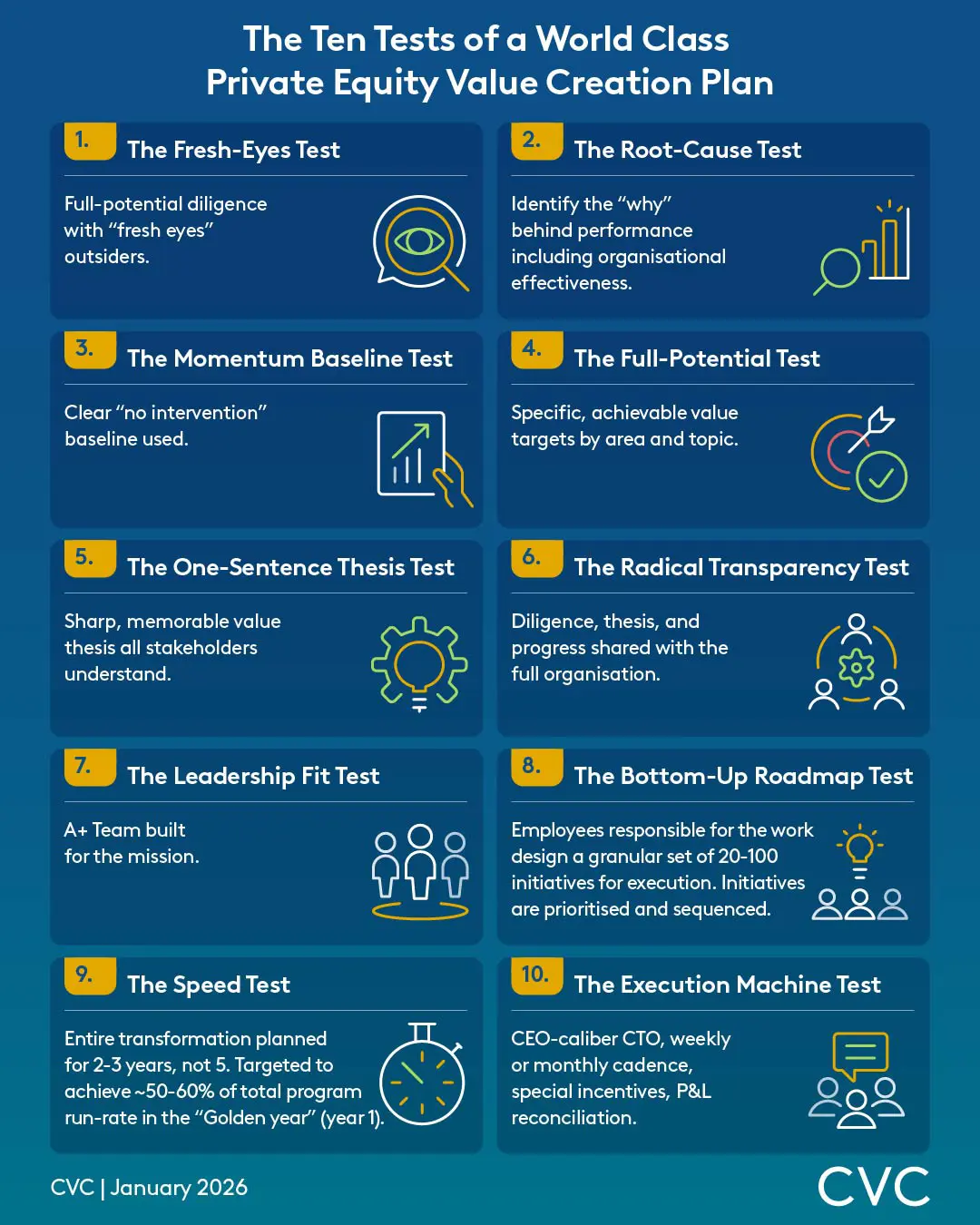
Ten Tests of a World-Class Private Equity Value Creation Plan
By John Kelleher, Managing Partner & Global Head of the CVC Operating Team
Recently, I’ve been travelling around the world meeting portfolio company CEOs, operating and deal partners from the private equity industry, and participating in roundtables and industry events.
A common question — maybe the most common question — that keeps coming up is: what makes a truly world-class value creation plan in private equity?
I’ve seen hundreds of Value Creation Plans (VCPs) — only a small percentage of them drive truly outsize results.
Over the years, I’ve developed what I call the “10 Tests of a World-Class VCP in Private Equity (PE)” — a simple tool I apply when I dig in to understand whether a value creation plan is genuinely meeting the bar, and when it does not.
When plans can’t pass these tests, it is often the case that what you have is a value creation dream and not a value creation plan. To go from value creation dreams, to value creation plans, to value creation results (which is the goal!) — these ten tests are essential.
The lessons come from battle-tested experience over two decades of leading, driving, and monitoring VCPs as a CEO, operating partner, and board director.
I have also recently updated a few of the tests based on some extremely useful feedback I received from top operating partners and PE CEOs around the world.
Ten Tests of a World-Class Value Creation Plan
1. The Fresh-Eyes Test
Did the plan start with a truly independent diligence — quantified, rigorous, and involving outsiders with the right expertise who don’t work here and don’t care about internal politics? A time-boxed diligence — usually around 6–10 weeks of intense effort — should be at the start of every VCP.
Independent challenge and expert outside perspectives must shape the diligence. If not, you are likely “thrilled with your own cooking.”
2. The Root-Cause Test
Did the diligence go beyond “what is performance” to “what drove the root causes of performance” — strategy, organizational effectiveness, commercial practices, operations, and execution discipline?
“Revenue was down 10%” is a fact.
“Sales training, collateral, and incentives are far off market” is a root cause.
3. The Momentum Baseline Test
Did you explicitly define the momentum case — where the business is headed without management intervention — and use that as the correct planning base for initiatives?
If you are quantifying opportunities on quicksand, you will not end up where you think you will.
4. The Full-Potential Test
Did the diligence produce a credible, achievable full-potential case, broken down by topic and business area? Did the exercise identify all recurring EBITDA opportunities as well as one-time opportunities (divestitures, working capital, cash, etc.)?
One number ≠ a plan.
A decomposed value bridge does.
5. The One-Sentence Thesis Test
Can the value creation thesis be synthesized into one sharp sentence that any employee can remember and understand in five seconds?
Examples:
- “Bring the jets home to increase revenue by $1B”
- “Provide the consistently lowest-cost mobile plan in the industry, with acceptable connectivity and customer service”
- “Power the data-center revolution with the fastest maintenance response time”
If it needs a 100-page slide deck to explain, it won’t survive contact with reality.
6. The Radical Transparency Test
Was the thesis — and the diligence behind it — clearly read out to the whole organization, not just the board and the top team? And is the whole company being kept up to date on progress against the VCP monthly?
You can’t enroll the troops if they don’t understand the problems, the opportunities, and how progress is going. Too many CEOs and PE partners underestimate the power of enrolling the whole organization in the change.
7. The Leadership Fit Test
Did you deliberately assemble an A+ board, CEO, CFO, and management team for this thesis — not simply the people who happened to be there? Are they all fully aligned and energized to pursue the VCP at pace?
A VCP without outstanding leadership and fit is doomed before it starts.
Leadership fit also extends to organizational maturity in general. Many VCPs fail because portfolio companies try to do too much at once without having the organizational capacity, capabilities, and readiness to succeed. The best VCPs test not only for A+ leadership and fit with the thesis, but also with these general organizational readiness topics.
8. The Bottom-Up Roadmap Test
Did you run a time-boxed (less than 90 days) bottom-up roadmap (BUR) where the people who actually do the work built the execution plans?
Way too many VCPs fail because the people who will do the work weren’t asked to build the plan. No involvement = no buy-in.
A good rule of thumb is that if at least 10 percent of employees aren’t involved as initiative owners or supporting a workstream or initiative, it will be very hard to achieve the VCP and make it stick. Best practice looks more like 25 percent or higher (yes, that’s a lot!).
All staff should understand the thesis, the targets, and progress against the VCP. The “man or woman on a horse” strategy to execute VCPs is a mistake — real leaders use the entire team to transform the company.
The Bottom-up roadmap must also be granular, with 20–100 initiatives, each with:
- a named owner
- financial impact including cost to achieve
- an execution plan
The plan overall must also be tested for liquidity and covenant headroom: does the organization have the financial capacity to execute the plan.
If you can’t point to initiative #23 and say who owns it and how it’s performing versus plan, you’re bluffing.
And last, the initiatives in the bottom-up roadmap must be prioritized and sequenced. The most important initiatives — and the critical enabling initiatives — must be done first, and that must be reflected in the plan. Sequencing should also contemplate required resources including critical enablers (e.g. systems, reporting, staff, training, etc) and the interdependencies between initiatives in particular.
A great BUR is not just a laundry list of initiatives. It should be the right granular set of initiatives, in the right order, to ensure execution success.
9. The Speed Test
Great operators know that to drive true transformation, speed is positively correlated with success. Far too many transformations fail because — ironically, to some — they gave the plan too much time. Short timelines maximize your chances of success.
More specifically, too many transformations are planned around 5-year underwriting timelines. This is good for underwriting, bad for management and execution. This is often the first mistake. Almost every transformation can be achieved in two, at most three, years. These should be the standard planning horizons for management teams.
It is also essential to use the first year of the transformation — the “Golden Year” — to achieve maximum impact. Having a highly successful first year of transformation is perhaps the biggest predictor of a CEO’s ability to achieve the full transformation target. The bottom-up roadmap should plan to achieve around 50–80% of the total transformation target on a run-rate basis by the end of the Golden Year.
A common characteristic we look for in best-in-class BURs is: “reverse hockey stick” patterns: benefit curves that show big financial impact quickly instead of waiting to see them near the end of the plan. A plan that has all of its benefits back end loaded is a major red flag.
To get there, management should plan and execute the toughest and hardest decisions first. Move fast on the biggest initiatives. Ensure that Year 1 is a big financial success.
10. The Execution Machine Test
The best VCPs include the creation of an “execution machine” at the center of the company – they view the machine as a vital part of the plan.
The execution machine is:
- a clear workstream structure
- a CEO-calibre Chief Transformation Officer reporting to the CEO, with real authority, who challenges everyone to meet and exceed plans
- special incentives for initiative owners and transformation leadership
- a dedicated VCP finance lead
- a system/database to track performance of every initiative – one “source of truth”
- a weekly/monthly cadence that reviews every initiative
- reconciliation of VCP impact to the actual P&L and balance sheet
If results aren’t showing up in the reported numbers, they’re not results. And if you don’t build an execution machine at the center of the company, you won’t achieve full potential — and it won’t stick.
Of course, as in all of management and leadership there is nuance in the above.
In a large company, with a large and/or complex VCP, the ten tests are essential. In smaller or less complex situations, judgment and experience are required to calibrate the tests to the context.
But the brutal truth remains:
Most “value creation plans” fail by Test #3.
Almost all fail by Test #9.
Very few pass all ten.
Passing these doesn’t guarantee success — but failing any of them guarantees problems. And the more you don’t pass, the overall chance of failure goes up exponentially.